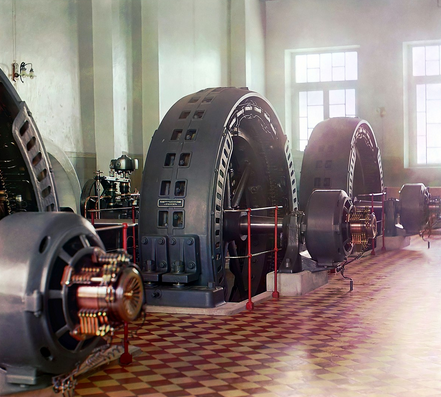
The Electricity Fairy has given us the light. Both material light, that makes us feel secure in the night, and the psychic light, the knowledge of the Internet that crosses borders.
The Internet was a huge technological revolution. It's considered as one of the major technological revolutions, after writing and agriculture.
The Internet was first described as a source of information. It has reached its golden age in 2006. After this time, it has slowly been replaced by stupid TV uses, and from 2019, the Internet has become a system of oppression, with, on one side, the bad people who spy on people's lives and want to sell their shit, and on the other side, the stupid people who tell about their lives and buy this shit. Good people like me are an old minority, and maybe in the future we will find our happiness in the
Wood Wide Web.
Besides, it seems obvious that some countries cannot get on well with each other, leading to a divergence of several informatic networks. This can already be seen in dictatorships, that do not allow access to the network of "democratic" countries.
All children are curious, so there is hope ! Children are positive, sincere, brave, full of energy, logical... They have everything, except experience ! When the elders give their experience to the children and when the children give their youth to the elders, we have the best exchange between old and young ! :-)

We shall make electricity with the energies of the sky : the water, the sun, and the wind. They are all clean and renewable.
1- Source
1) Water
Water is the cheapest way to make electricity. Let's look at some data from Global Chance
1Pour la science (French magazine), April 2012, pp. 32-33.
- Hydraulic electricity : 30 €/MWh ;
- Nuclear electricity : 49 €/MWh ;
- Fossil electricity : 60 €/MWh ;
- Earth wind electricity : 80 €/MWh ;
- Biomass electricity : 150 €/MWh ;
- Ocean wind electricity : 180 €/MWh ;
- Photovoltaic electricity : 300 €/MWh.
From this data, hydro-electricity appears as the cheapest.
Fossil and nuclear electricity are not compatible with autonomous building.
We could think that hydro-electricity is cheap only in large dams that destroy the territory. It's not the case.
In Auvergne, the Brauchli micro-hydraulic powerplants
2http://www.hydro-ber.com/about cumulate 539 kW of electricity, for an investment of 25,000 €. Your autonomous house will need 200 W of electricity if you listen to my tips. It would mean an investment of 11 $ (!) if just proportional.
You get it, water electricity is cheap, even at a small scale. If you settle close to a river and manage to protect your house from floods, you are making a nice choice for both the hydraulic and the electricity systems.
The water makes the water wheel rotate, that makes the generator rotate, that makes the cheapest electricity. And the fishes have their space ! :-)
2) Sun
The Earth receives from sunlight more than 10,000 times the energy that humanity consumes
3http://www.photovoltaique.info/-Le-soleil-source-d-energie-.html. In sunny countries, solar electricity has become cheaper than conventional electricity.
If you don't make hydro-electricity, look at the local meteorological data. There's a lot of sun, regularly throughout the year ? Make solar electricity. There's a lot of wind, regularly throughout the year ? Make wind electricity.
The best way to make electricity from the Sun is photovoltaic.
Photovoltaic modules. They transform sunlight into electricity.
Classical photovoltaic is made of silicon. They can be monocrystalline, polycristalline, or amorphous.
In terms of quality, monocrystalline > polycrystalline > amorphous. Monocrystalline is the best. It has the biggest crystals, allowing more resistance and better efficiency.
If you are interested in price, please consider cadmium-telluride (CdTe) technology. CdTe photovoltaic modules offer the cheapest solar electricity. However, cadmium is a hazard for chemists, tellurium is very rare, and you will need a higher surface.
How much photovoltaic area do you need ? It's given by the formula
A= 1.6 (P/η) cos L
where
- A is the area you need. You can express it in m² ;
- 1.6 is an sizing factor you need to balance the losses (20 % losses with aging, 15 % losses from temperature, 5 % losses from the inverter) ;
- P is your annual mean electrical consumption. You can express it in Watts. We are talking about the power, the energy flow in Watts, not about the static energy in Joules, Calories or kWh ;
- I is the annual mean horizontal irradiance. It's the average power of sunlight received by a horizontal area. You can express it in W/m² ;
η is the efficiency of your PV modules. It can be 21 % for a good monocrystalline system, 11 % for a CdTe system ;
cos L is an annual bonus you earn by placing your modules not horizontally, but at the right angle. If you live at 43° N, you have to place them 43° from the horizontal towards the South. It's called the latitude rule.
Think about the roof. On one side, photovoltaic needs to catch the most sunlight, on the other side, photothermic needs to avoid overheating in summer. Therefore, they have different angle requirements.
How to find the efficiency ? They just show the peak power !
... Yes, that's a common problem -_- . The peak power is the power you would get with 1000 W/m² of laboratory AM1,5 simulated sunlight at 25 °C
4Installations photovoltaïques, Labouret and Villoz, Dunod, 2012, p. 51, that is, in other words, the maximum power !
You will just not have the peak power. We should rather talk about mean power, based on the local meteorology, the efficiency, and the surface.
The lifetime is very important. If your system lasts 2 times longer, your electricity costs 2 times less. Good engineers can improve it, but a big hail can destroy it anytime. You need to understand that meteorology is fundamental in autonomous building.
3) Wind
Wind power is a complement to solar power. Why ? Because there is more sun in summer, and more wind in winter. According to
5L'énergie éolienne, Rapin and Noël, Dunod, 2014, p. 241, there are faster winds in France in winter.
First, ask yourself. Is the location windy enough ? The coast is windy, with regular winds. A hilltop is also windy, with gusts.
As you can see in this diagram from
The autonomous house, choosing a hilltop instead of a plain, can increase by more than 80 % the wind speed, offering a bonus of more than 480 % in power. Yes, you can be the king of the mountain.
Wait a minute ?! A bonus of 80 % in speed giving a bonus of 480 % in power ? Yes, and I'll explain you why.
The power generated by a wind turbine is determined by the formula
6Le tour du monde des énergies, JC Lattès, 2009, p. 147.
P=(1/2) ρ A x v
3 x C
p
where
- P is the power generated ;
- ρ is the density of the fluid ;
- A is the area of the blades ;
- v is the speed of the wind ;
- Cp is a coefficient of performance depending on the machine.
You see the v
3 term ? This one is crucial. It means that the power is very sensitive to the speed of the wind.
For example, if you multiply the speed by 2, you multiply the power by 2
3, that is 8. If you multiply the speed by 3, you multiply the power by 3
3, that is 27.
Today, the classical wind turbines are Danish. They are made with thin blades, in order to start at slow winds. But they are made with three blades, in order to get the maximum coefficient of performance
7L'énergie éolienne, Rapin and Noël, Dunod, 2014, p. 116.
Classical Danish wind turbines.
But I guess that two blades are actually more performant to catch fast winds. Why ? Look at the figure below.
Two blades reach a nice coefficient of performance, nearly the best. And it happens at higher specific speeds, which seem likely to the wind speeds in the literature. Maybe two blades can produce more power, catching the peaks of fast winds.
It's impossible to make a wind turbine that works at fast speeds.
(Really ?)
Actually, the CIAMO (Compagnie Industrielle des AéroMOteurs), founded in 1955, went into adventure. They have developed the FP5 and FP7 wind turbines, designed to work in cyclonic conditions. They were working from 3 m/s to 90 m/s
8L'énergie éolienne, Rapin and Noël, Dunod, 2014, p. 52. In my opinion, they have made the most powerful system of history of wind power.
Most garden wind turbines are used in wind-poor places, or undersized. I suggest you invest in a large Danish system. Before you pay, ask to the manufacturer for the curve of power ouput depending on wind speed, and find out the local annual mean speed of the wind. Read the graphic and see if your system is undersized or oversized. Ask them.
Manufacturers of wind turbines should always give this power curve. Remember the power of a wind turbine always depends on the wind speed.
Let's talk about the noise. Actually, wind turbines are like women : the more they turn, the better !
Seriously. In the city of Freiburg in Germany, there's a hill called Rosskopf, in the East, that has four wind turbines. They turn slowly, in order to avoid hurting the bats. I went there, and they were making less noise than the song of the birds in the forest.
You can avoid blackout thanks to the storage of electrical energy.
2- Storage
If you store the excess of production, and use it in time of need, then you will know no intermittence.
Actually, we can store electrical energy. This can be done by transforming electricity into another form of energy, then transform it again into electricity. A part of the energy will be lost.
The superconducting magnetic energy storage (SMES) has 95 % efficiency, however, it can be used only at extremely cold temperatures.
The pumped-storage powerplant (PSP), a hydraulic system, can store electrical energy with up to 85 % efficiency. However, this system doesn't suit for an autonomous house.
The compressed air energy storage system (CAES) allows a similar efficiency, and this could be done with a tank in your garden
9Xavier PY, lessons of thermal storage, Université de Perpignan Via Domitia, 2016.
The most common system is the batteries.
Lead batteries are the ones used for off-grid electricity systems, because we can measure their state of charge.
The batteries allow you to store electricity for 1 day, maybe 1 week. They are too expensive for an annual storage. If you want an annual storage, then you have to ask to the companies of CAES to do it for your household.
3- Consumption
The electricity consumption can be reduced without decreasing the standard of life.
How ?
First, you should get rid of all electrical machines you don't need. You can put your TV to the waste center, an autonomous house doesn't need it. It would be like entering a church with a bikini : you will not stay long.
Second, you can make a magic trick by separating the electrical and the thermal system. If you do so, you divide your electricity consumption by 6 !
As you can see from this diagram, 84 % of the consumption of electricity in a household in France comes from electrical heating. A huge lack of energy efficiency that needs a revolution : thinking thermics for itself.
Third, prefer low consumption devices, like LED lamps, that consume 1-5 W instead of the 60 W of incandescent lamps.
Fourth, switch off the systems you don't use, naturally.
Fifth, invite the fairies in your garden. What do I mean ?
Solar lanterns catch the light from the Sun during the day and release light during the night. They exist in sedentary and nomad models, and also in rainbow lights !